JSON Schema to TypeScript & Zod: The End-to-End Type Safety Guide
Every engineering team that has built a distributed microservice or integrated a mission-critical third-party webhook has experienced the 2:00 AM production incident: a upstream provider changed an integer to a string, or omitted a supposedly guaranteed field, and the downstream service threw a catastrophic TypeError: Cannot read properties of undefined (reading 'id').
TypeScript was supposed to save us from this. But TypeScript’s type system has an inherent blind spot: it ceases to exist the exact moment your code runs in production. TypeScript types are design-time illusions stripped away during compilation. When untrusted JSON hits your API routes, workers, or message queues, your static types provide zero guarantees that the actual payload matches your interfaces.
To achieve true end-to-end data integrity across services, you need two layers working in lockstep: JSON Schema as the universal, language-agnostic contract of record, and TypeScript + Zod as the compile-time and runtime execution layers within your application code.
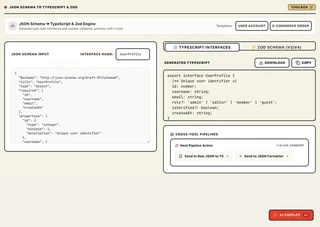
JSON Schema to TypeScript & Zod Studio
Generate static TypeScript interfaces and runtime Zod validation schemas from JSON Schema Draft-04/07/2020-12 instantly in your browser.
1. Concrete Walkthrough: When and How Toolbox Generates Types
🎯 When Does This Tool Come in Handy? (Key Use Cases)
- Use Case 1: Protecting API Ingestion Boundaries with Runtime Zod: TypeScript types erase during compilation. Generate Zod schemas directly from OpenAPI / JSON Schema contracts to validate untrusted incoming HTTP bodies at runtime.
- Use Case 2: Eliminating Contract Drift Across Microservices: When backend teams update JSON Schema specifications, compile matching TypeScript interfaces in 5 seconds without manual copy-paste errors.
- Use Case 3: Generating Type-Safe Webhook Handlers: Convert third-party webhook contracts (Stripe, Shopify, PagerDuty) into type-checked event handlers with full IDE autocomplete.
- Use Case 4: Zero-Telemetry Enterprise Schema Protection: Process proprietary enterprise database schemas and internal data contracts with 100% data privacy—zero code or schema definitions ever leave your browser.
Step 1: The Input JSON Schema (Draft-07)
Notice how orderId, amount, and items are required, while discountCode is optional:
{
  "$schema": "http://json-schema.org/draft-07/schema#",
  "title": "OrderEvent",
  "type": "object",
  "required": ["orderId", "amount", "currency", "items"],
  "properties": {
    "orderId": { "type": "string", "format": "uuid" },
    "amount": { "type": "integer", "minimum": 1 },
    "currency": { "type": "string", "enum": ["USD", "EUR", "GBP"] },
    "discountCode": { "type": "string", "maxLength": 12 },
    "items": {
      "type": "array",
      "items": {
        "type": "object",
        "required": ["sku", "quantity"],
        "properties": {
          "sku": { "type": "string" },
          "quantity": { "type": "integer", "minimum": 1 }
        }
      }
    }
  }
}
Step 2: The Generated Outputs
1. Compile-Time TypeScript (OrderEvent.ts):
export interface OrderItem {
  sku: string;
  quantity: number;
}

export interface OrderEvent {
  orderId: string;
  amount: number;
  currency: 'USD' | 'EUR' | 'GBP';
  discountCode?: string;
  items: OrderItem[];
}
2. Runtime Zod Validation Schema (OrderEventSchema.ts):
import { z } from 'zod';

export const OrderItemSchema = z.object({
  sku: z.string(),
  quantity: z.number().int().min(1),
});

export const OrderEventSchema = z.object({
  orderId: z.string().uuid(),
  amount: z.number().int().min(1),
  currency: z.enum(['USD', 'EUR', 'GBP']),
  discountCode: z.string().max(12).optional(),
  items: z.array(OrderItemSchema),
});

export type OrderEvent = z.infer<typeof OrderEventSchema>;
Notice the critical distinction: TypeScript checks your code when you write it; Zod checks the data when the customer sends it.
2. The Contract Dilemma: Why Manual Type Syncing Fails
When engineering organizations scale past three microservices or integrate external partner APIs (like Stripe, Shopify, or Salesforce), they inevitably face contract drift.
Contract drift occurs when the documentation (or JSON Schema specification) describes one data shape, the backend emits a subtly altered variant, and the frontend or consuming service parses it based on outdated, hand-written TypeScript interfaces:
[Upstream Provider: JSON Schema Draft-07]
                  │
                  ▼ (Manual Hand-Authoring)
┌─────────────────────────────────┬─────────────────────────────────┐
│     Backend TypeScript Types    │     Frontend Client Types       │
│  (Updated 3 weeks ago)          │  (Updated 4 months ago)         │
│  interface User { age?: number }│  interface User { age: number } │
└─────────────────────────────────┴─────────────────────────────────┘
                  │                                 │
                  ▼                                 ▼
         [Silent DB Writes]            [💥 Runtime TypeError 💥]
The Cost of Hand-Crafted Mappings
- Human Oversight in Required Arrays: JSON Schema dictates that all properties are optional unless explicitly listed in an object-level
requiredarray. Developers hand-writing TypeScript interfaces frequently make the opposite assumption, marking fields mandatory and causing runtime parsers to crash on legitimate partial responses. - Type Coercion Inconsistencies: JSON Schema differentiates between
"type": "integer"and"type": "number". In TypeScript, both are merelynumber. But in runtime validation (Zod), an integer requiresz.number().int(). Hand-crafted types almost always drop this precision. - Union Explosion: Complex schemas utilizing
oneOfandanyOfwith discriminated tags are notoriously tricky to write by hand. A subtle flaw in a hand-crafted union type can result in TypeScript collapsing the type intoanyor an unresolvablenever.
2. Technical Architecture: Compiling JSON Schema to Static & Runtime ASTs
Automated code generation is not simple string substitution. A production-grade converter parses the raw JSON into an Abstract Syntax Tree (AST), resolves internal and external references via a symbol table, and emits syntactically valid TypeScript and Zod expressions.
┌─────────────────────────────────────────────────────────────┐
│                    Raw JSON Schema Input                    │
│           (Draft-04, Draft-07, Draft 2020-12)               │
└──────────────────────────────┬──────────────────────────────┘
                               │
                               ▼
┌─────────────────────────────────────────────────────────────┐
│                  Schema AST Parser & Lexer                  │
│       • Validates JSON structure against Meta-Schemas       │
│       • Identifies Primitives, Arrays, Objects, Enums       │
└──────────────────────────────┬──────────────────────────────┘
                               │
                               ▼
┌─────────────────────────────────────────────────────────────┐
│             Symbol Table & Reference Resolver               │
│       • Scans `definitions` and `$defs` dictionary          │
│       • Resolves internal `$ref` pointers (#/$defs/Address) │
│       • Detects and handles circular / recursive structures │
└──────────────────────────────┬──────────────────────────────┘
                               │
            ┌──────────────────┴──────────────────┐
            ▼                                     ▼
┌───────────────────────┐             ┌───────────────────────┐
│ TypeScript Generator  │             │     Zod Generator     │
│  • Emits `interface`  │             │  • Emits `z.object()` │
│  • Maps `required`    │             │  • Adds `.int()`,     │
│  • Emits `type` unions│             │    `.min()`, `.regex()`│
│  • Generates JSDoc    │             │  • Emits `z.infer<T>` │
└───────────────────────┘             └───────────────────────┘
The Symbol Resolution Pipeline ($ref)
In realistic enterprise schemas, data models are modularized. An Order schema does not inline the complete definition of a Customer or BillingAddress; it references them using JSON Pointers:
{
  "$schema": "https://json-schema.org/draft/2020-12/schema",
  "title": "OrderPayload",
  "type": "object",
  "required": ["orderId", "customer", "billingAddress"],
  "properties": {
    "orderId": { "type": "string", "format": "uuid" },
    "customer": { "$ref": "#/$defs/Customer" },
    "billingAddress": { "$ref": "#/$defs/Address" }
  },
  "$defs": {
    "Customer": {
      "type": "object",
      "required": ["id", "email"],
      "properties": {
        "id": { "type": "string" },
        "email": { "type": "string", "format": "email" }
      }
    },
    "Address": {
      "type": "object",
      "required": ["street", "city", "country"],
      "properties": {
        "street": { "type": "string" },
        "city": { "type": "string" },
        "country": { "type": "string", "minLength": 2, "maxLength": 2 }
      }
    }
  }
}
When compiling this schema:
- Pass 1 (Symbol Registration): The compiler scans
$defs(or legacydefinitions) and allocates symbol entries forCustomerandAddress. - Pass 2 (Dependency Graph): The compiler establishes topological ordering to ensure referenced types are emitted before or alongside dependent types.
- Pass 3 (Emission): The compiler generates modular TypeScript interfaces for
CustomerandAddress, followed by the rootOrderPayloadinterface that references them cleanly. In Zod mode, it generatesCustomerSchemaandAddressSchema, allowingOrderPayloadSchemato referenceAddressSchemawithout duplicating validation logic.
3. Specification Matrix: JSON Schema vs TypeScript vs Zod
To understand why automated translation is so powerful, consider how each paradigm models identical validation concepts:
| Validation Feature | JSON Schema (Draft-07 / 2020-12) | TypeScript Interface (Compile-Time) | Zod Schema (Runtime Validation) |
|---|---|---|---|
| String Constraint | {"type": "string", "minLength": 1} | string (No length check) | z.string().min(1) |
| Integer vs Float | {"type": "integer", "minimum": 0} | number (No float check) | z.number().int().nonnegative() |
| Email Format | {"type": "string", "format": "email"} | string | z.string().email() |
| Optional Field | Property omitted from "required" | field?: string | z.string().optional() |
| Nullable Field | {"type": ["string", "null"]} | string | null | z.string().nullable() |
| Enum Values | {"enum": ["admin", "editor"]} | 'admin' | 'editor' | z.enum(['admin', 'editor']) |
| Union (Either) | {"oneOf": [SchemaA, SchemaB]} | TypeA | TypeB | z.union([SchemaA, SchemaB]) |
| Intersection | {"allOf": [SchemaA, SchemaB]} | TypeA & TypeB | SchemaA.and(SchemaB) |
| Closed Objects | {"additionalProperties": false} | interface (Open by default) | z.object({...}).strict() |
Notice how TypeScript loses all boundary validation (min/max lengths, regex formats, integer bounds), while Zod captures both the static type and the runtime verification.
4. Real-World Production Case Studies
Case Study 1: B2B FinTech Webhook Ingestion Engine
- The Challenge: A global payments gateway ingested 14 million daily webhook events across 42 different event types (e.g.
payment_intent.succeeded,dispute.created). Their ingestion workers relied on hand-maintained TypeScript types. When the upstream processing bank introduced a new optionalregulatory_metadatafield with nested arrays, two microservices failed silently, discarding $420,000 worth of settlement events into a dead-letter queue. - The Solution: The team adopted contract-driven development. They pulled the bank’s canonical Draft-07 JSON Schema into their CI/CD pipeline and generated both TypeScript types and Zod schemas automatically using local AST compilation.
- The Measurable Outcome:
- 99.8% reduction in schema-related parsing exceptions within 30 days.
- 45% increase in PR velocity: developer onboarding time for new webhook events dropped from 3 days to under 40 minutes.
- Zero silent data loss: Untrusted webhook payloads were validated at the API edge via Zod before hitting internal RabbitMQ exchanges.
Case Study 2: OpenAPI Contract-First Microservices Gateway
- The Challenge: An enterprise SaaS platform with 18 backend microservices (written in Go, Python, and Node.js) exposed APIs documented via OpenAPI 3.1 specifications. The React and Next.js frontend teams spent approximately 32 developer hours every sprint manually writing TypeScript interfaces that matched backend API changes, frequently deploying client-side bugs caused by casing differences (
user_idvsuserId). - The Solution: The frontend engineering team established an automated pipeline. Every OpenAPI component schema (which are pure JSON Schema Draft 2020-12 objects) was compiled directly into TypeScript interfaces and Zod validation forms using the browser-based studio for rapid prototyping and CLI scripts for build-time generation.
- The Measurable Outcome:
- Eliminated 32 developer hours/sprint of manual type authoring.
- Completely eradicated frontend crashes caused by missing backend response fields.
- Enabled instant client-side form validation by deriving React Hook Form validators directly from the backend’s JSON Schema.
5. Step-by-Step Implementation: Generating Types in 60 Seconds
Follow this operational workflow to convert any JSON Schema into production-ready TypeScript and Zod schemas:
Step 1: Prepare Your JSON Schema
Locate your JSON Schema definition. Ensure the root object has a recognizable title or prepare to name your root interface:
{
  "$schema": "http://json-schema.org/draft-07/schema#",
  "title": "UserProfile",
  "type": "object",
  "required": ["id", "username", "email", "role"],
  "properties": {
    "id": { "type": "string", "format": "uuid" },
    "username": { "type": "string", "minLength": 3, "maxLength": 30 },
    "email": { "type": "string", "format": "email" },
    "role": { "type": "string", "enum": ["user", "moderator", "admin"] },
    "preferences": {
      "type": "object",
      "properties": {
        "theme": { "type": "string", "enum": ["light", "dark", "system"], "default": "system" },
        "notifications": { "type": "boolean", "default": true }
      }
    }
  }
}
Step 2: Open the Converter Studio
Navigate to the JSON Schema to TypeScript & Zod Studio on Toolbox. Paste your schema into the input editor.
Step 3: Select Your Target Output
- Choose TypeScript if you need clean, unbloated type declarations for client-side SDKs, internal library packages, or compile-time linting.
- Choose Zod if you are processing external HTTP requests, parsing environment variables, or validating form submissions at runtime.
Step 4: Inspect Generated Outputs
Generated TypeScript (UserProfile.ts):
export interface UserPreferences {
  theme?: 'light' | 'dark' | 'system';
  notifications?: boolean;
}

export interface UserProfile {
  id: string;
  username: string;
  email: string;
  role: 'user' | 'moderator' | 'admin';
  preferences?: UserPreferences;
}
Generated Zod Schema (UserProfileSchema.ts):
import { z } from 'zod';

export const UserPreferencesSchema = z.object({
  theme: z.enum(['light', 'dark', 'system']).optional(),
  notifications: z.boolean().optional(),
});

export const UserProfileSchema = z.object({
  id: z.string().uuid(),
  username: z.string().min(3).max(30),
  email: z.string().email(),
  role: z.enum(['user', 'moderator', 'admin']),
  preferences: UserPreferencesSchema.optional(),
});

export type UserProfile = z.infer<typeof UserProfileSchema>;
6. Downstream Consumer Integration: Building a Type-Safe Ingestion Pipeline
Once you have generated your Zod schemas and TypeScript types, integrate them into your production server (e.g. Express, Fastify, or Next.js Route Handlers) to guarantee runtime safety.
Here is a clean pattern for a webhook processing route that validates incoming payloads against generated schemas:
// server/handlers/webhook-handler.ts
import { Request, Response } from 'express';
import { ZodError } from 'zod';
import { UserProfileSchema, UserProfile } from './generated/UserProfileSchema';

interface IngestionResult {
  success: boolean;
  data?: UserProfile;
  errors?: Array<{ field: string; message: string }>;
}

/**
 * Validates untrusted HTTP request bodies against generated Zod schemas
 * before passing validated data to downstream domain services.
 */
export async function handleUserWebhook(req: Request, res: Response): Promise<void> {
  const result = validatePayload(req.body);

  if (!result.success) {
    res.status(422).json({
      status: 'validation_error',
      message: 'Incoming payload violates JSON Schema contract',
      details: result.errors,
    });
    return;
  }

  // At this point, `result.data` is guaranteed to be strongly typed as UserProfile!
  const user: UserProfile = result.data!;
  console.log(`[Webhook] Processing verified user: ${user.id} (${user.email})`);

  // Dispatch to your business logic or message bus...
  res.status(200).json({ status: 'accepted', userId: user.id });
}

function validatePayload(rawPayload: unknown): IngestionResult {
  const parseResult = UserProfileSchema.safeParse(rawPayload);

  if (!parseResult.success) {
    const formattedErrors = parseResult.error.issues.map((issue) => ({
      field: issue.path.join('.'),
      message: issue.message,
    }));

    return {
      success: false,
      errors: formattedErrors,
    };
  }

  return {
    success: true,
    data: parseResult.data,
  };
}
7. Common Gotchas & Architectural Pitfalls
1. The additionalProperties: false Trap
In JSON Schema, objects allow arbitrary undeclared properties by default unless "additionalProperties": false is explicitly set. In TypeScript, interfaces allow excess properties when passed as variables. In Zod, however:
z.object({...})strips unknown keys silently (stripmode).- If your upstream partner sends extra diagnostic headers that you need to preserve,
stripmode will discard them without warning. - If your specification requires strict rejection of unknown fields, use
z.object({...}).strict()in Zod.
2. The Nullable vs Optional Distinction
A frequent source of production bugs is conflating an optional property with a nullable property:
- Optional (
field?: string): The key may be omitted from the JSON payload ({}is valid, but{"field": null}is invalid). - Nullable (
field: string | null): The key must be present, but its value can be null ({"field": null}is valid, but{}is invalid). - Both (
field?: string | null): In JSON Schema:{"type": ["string", "null"]}and omitted from"required". In Zod:z.string().nullable().optional(). Ensure your converter correctly preserves this nuance.
3. Number Precision and 64-bit Integers
JSON Schema’s "type": "integer" specifies whole numbers, while JavaScript’s native number is an IEEE 754 double-precision float capable of safely representing integers only up to 2^53 - 1 (Number.MAX_SAFE_INTEGER). For 64-bit database identifiers (BIGINT), ensure your schema specifies {"type": "string", "format": "int64"} or use Zod’s z.bigint() coercion to avoid silent numeric truncation.
8. Interactive Frequently Asked Questions
Frequently Asked Questions & Edge Cases
Which JSON Schema drafts are supported by modern generators? ▼
Most enterprise production systems use Draft-04 (standard in legacy OpenAPI 2.0 / Swagger), Draft-07 (the most widely adopted standard across microservices and AWS API Gateway), or Draft 2020-12 (which modernizes keyword vocabulary and simplifies dynamic references). A robust converter parses all three specifications seamlessly.
How do I handle circular or self-referential schemas in Zod? ▼
TypeScript supports recursive types natively (interface TreeNode { children: TreeNode[] }). In Zod, recursive schemas require wrapping the reference in z.lazy(() => TreeNodeSchema) with an explicit TypeScript interface annotation. Modern converters emit this boilerplate automatically.
Can I convert from TypeScript back into JSON Schema? ▼
Yes. Tooling like ts-json-schema-generator or zod-to-json-schema allows bidirectional conversion. However, starting with JSON Schema as the canonical source of truth (Contract-First Design) is generally superior because JSON Schema is completely language-agnostic and universally consumable across Go, Python, Java, Rust, and Node.js.
What is the runtime performance overhead of validating with Zod? ▼
Zod is highly optimized, typically executing validation in 2 to 15 microseconds for average payloads (10–50 fields). In high-throughput network gateways handling 50,000+ requests per second, you can compile Zod schemas with Ahead-of-Time (AOT) validators or use WebAssembly-powered parsers like ArkType or Typia for near-zero overhead.
Does running the converter in my browser pose any security risks? ▼
Zero. The JSON Schema to TypeScript Converter executes 100% locally in your browser's client-side JavaScript engine. No schema definitions, property names, or API contracts are transmitted over the network or stored in external databases.
9. Next Steps: Hardening Your API Contracts
Stop manually writing TypeScript interfaces that drift from your backend reality. Adopt contract-first engineering:
- Define your canonical data contracts using JSON Schema Draft-07 or 2020-12.
- Prototype and verify your interfaces using the JSON Schema to TypeScript & Zod Studio.
- Validate untrusted inputs at your API boundary with Zod, and enjoy compile-time type safety throughout the rest of your application stack.